Aug 23, 2017

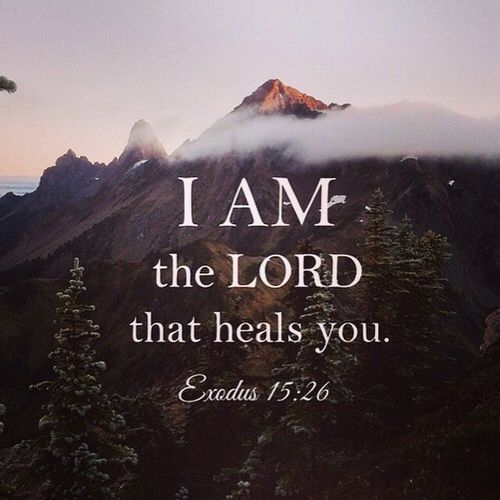
Jehovah-Rapha; I am the LORD, who heals you! ~ Exodus 15:26

Ed's Note: Jehovah Rapha is one of the compound redemptive names of Jehovah-God. 
God is and becomes the answer to whatever your needs are.  

...my Provider, my Everpresent Help, my Righteousness, my Creator, my Sufficiency, my Healer, my Banner (he even goes ahead of me), my Peace,
my Owner, my Master, my Judge, my Lord of All, my Shepherd...

Related Posts:   
He is my Everything ~ The Compound Redemptive Names of God  and 
"I AM WHO I AM".


Image result for I am the God that healeth thee

He said, "If you listen carefully to the LORD your God and do what is right in his eyes, if you pay attention to his commands and keep all his decrees, I will not bring on you any of the diseases I brought on the Egyptians, for I am the LORD, who heals you (HEBREW; "Jehovah Rapha")." 
~ Exodus 15:26

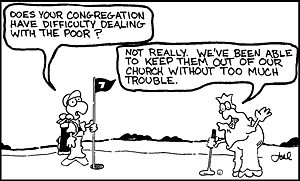
Dealing with the Poor? 😎

Related image😎

#6 - Do Not Murder ~ Dennis Prager

Editor's Note:    An Orthodox Jew Looks at the 10 Commandments:

The Ten Commandments ~ from Exodus 20

13“You shall not murder.

In 2009, Dennis Prager started a website, Prager University, offering five-minute videos on various subjects such as the Ten Commandments, the minimum wage, the Middle EastGlobal warming, and happiness with a conservative perspective.  To be very clear, Mr. Prager is NOT a Christian, but has his roots as an Orthodox Jew, thus his videos do not necessarily view scripture exactly as Christians view scripture, nonetheless there are many general parallels between.  Here is another video in this series:


If asked to state this Commandment, most people would say "Do Not Kill." This is understandable because the classic King James Bible translates it this way. But the English language has changed since 1610. Furthermore, Hebrew has two words for killing just as English does. The correct translation, as Dennis Prager explains, is "Do Not Murder." Once you grasp this, the meaning of the commandment changes entirely. 


Understanding the Hebrew Word for ‘Listen’ Will Change Your Relationship with God

Understanding this Hebrew word will Change your relationship with God!


I remember as a Communications major in college taking a class on listening (the only one of its kind in the nation at that time). I learned that research indicates that we “listen” more than we do any other communicative activity. However, that same research showed that we do a poor job of listening. An argument can be made that we shouldn’t have to listen to so much of the useless information that bombards us daily. As believers, we have someone—the Grand Informer Himself, God—we really need to listen to.Oftentimes we falsely assume that having ears equates to listening. This is especially applicable to a western culture that is saturated with headlines, texts, hashtags, posts, ear buds, and tweets. We are swimming in a sea of words while listening to very few of them.
Do the scriptures address this important issue of listening? The answer is a resounding and ancient “yes”!
In the following video from The Bible Project, a short word study is provided for the Hebrew word “shema”, which means “listen” or “hear”. Shema is the first word of the daily confession about God Jewish people have made ever since antiquity. The confession is referred to as the Shema and upholds the important theological truth about the oneness of God. The first mention of the shema is located in Deuteronomy:
“Hear, (or “Shema”) O Israel: The Lord our God, the Lord is one. You shall love theLord your God with all your heart and with all your soul and with all your might and these words that I command you today shall be on your heart. You shall teach them diligently to your children, and shall talk of them when you sit in your house, and when you walk by the way, and when you lie down, and when you rise. You shall bind them as a sign on your hand, and they shall be as frontlets between your eyes. You shall write them on the doorposts of your house and on your gates. Deuteronomy 6:4-9 (ESV)
We read in scripture that God is the maker of our ability to shema (Prov 20:12). But don’t be fooled: shema-ing is more than passively letting sound waves go into our ear canals. It can also mean to “pay attention to”; “to focus on”; but especially to “respond to what you are hearing”. Interestingly, to have someone listen is also asking to them to act. In Exodus 19:5, God equates listening to Him with keeping the covenants made by Him. Listening then, according to the wisdom of God, is to listen AND to obey. In Hebrew, which is the original language of the Old Testament, there is no distinct word for “obey”. In fact, according to Old Testament usage, to listen and to obey is the singular word of “shema”. So in light of the following video: How are we doing at truly listening to God?
In Exodus 19:5, God equates listening to Him with keeping the covenants made by Him. Listening then, according to the wisdom of God, is to listen AND to obey. In Hebrew, which is the original language of the Old Testament, there is no distinct word for “obey”. In fact, according to Old Testament usage, to listen and to obey is the singular word of “shema”. So in light of the following video: How are we doing at truly listening to God?

Blessed Assurance ~ Temple Baptist Church, Powell, Tennesse


  1. Blessed assurance, Jesus is mine!
    Oh, what a foretaste of glory divine!
    Heir of salvation, purchase of God,
    Born of His Spirit, washed in His blood.
    • Refrain:
      This is my story, this is my song,
      Praising my Savior all the day long;
      This is my story, this is my song,
      Praising my Savior all the day long.
  2. Perfect submission, perfect delight,
    Visions of rapture now burst on my sight;
    Angels, descending, bring from above
    Echoes of mercy, whispers of love.
  3. Perfect submission, all is at rest,
    I in my Savior am happy and blest,
    Watching and waiting, looking above,
    Filled with His goodness, lost in His love.

Signs Your Church May Be Headed Towards Progressive Christianity ~ Alisa Childers


Is your church going "...off the rails?"
Image result for off the rails

Several years ago, my husband and I began attending a local Evangelical, non-denominational church, and we loved it. We cherished the sense of community we found among the loving and authentic people we met there, and the intelligent, "outside the box" pastor who led our flock with thought-provoking and insightful sermons. Sadly, the church started going off the rails theologically, and after about a year and a half, we made the difficult decision to leave. Today that church is a self-titled "Progressive Christian Community." 

Back then I had never heard of "Progressive Christianity," and even now it is difficult to pin down what actually qualifies someone as a Progressive Christian, due to the diversity of beliefs that fall under that designation.  However, there are signs—certain phrases and ideas—that seem to be consistent in Progressive circles. Here are 5 danger signs to watch for in your church:

 1. There is a lowered view of the Bible 

One of the main differences between Progressive Christianity and Historic Christianity is its view of the Bible. Historically, Christians have viewed the Bible as the Word of God and authoritative for our lives. Progressive Christianity generally abandons these terms, emphasizing personal belief over biblical mandate.

Comments you might hear:

  • ​The Bible is a human book...
  • I disagree with the Apostle Paul on that issue...
  • The Bible condones immorality, so we are obligated to reject what it says in certain places...
  • ​The Bible "contains" the word of God...


2. Feelings are emphasized over facts

In Progressive churches, personal experiences, feelings, and opinions tend to be valued above objective truth. As the Bible ceases to be viewed as God’s definitive word, what a person feels to be true becomes the ultimate authority for faith and practice.

Comments you might hear:

  • That Bible verse doesn't resonate with me....
  • I thought homosexuality was a sin until I met and befriended some gay people....
  • I just can’t believe Jesus would send good people to hell....


3. Essential Christian doctrines are open for re-interpretation

Progressive author John Pavlovitz wrote, “There are no sacred cows [in Progressive Christianity]....Tradition, dogma, and doctrine are all fair game, because all pass through the hands of flawed humanity."
 Progressive Christians are often open to re-defining and re-interpreting the Bible on hot-button moral issues like homosexuality and abortion, and also cardinal doctrines such as the virgin conception and the bodily resurrection of Jesus. The only sacred cow is "no sacred cows." 

Comments you might hear:

  • The resurrection of Jesus doesn't have to be factual to speak truth....
  • The church's historic position on sexuality is archaic and needs to be updated within a modern framework...
  • The idea of a literal hell is offensive to non-Christians and needs to be re-interpreted....


​4. Historic terms are re-defined

There are some Progressive Christians who say they affirm doctrines like biblical inspiration, inerrancy, and authority, but they have to do linguistic gymnastics to make those words mean what they want them to mean. I remember asking a Pastor, "Do you believe the Bible is divinely inspired?" He answered confidently, "Yes, of course!" However, 
I mistakenly assumed that when using the word "inspired," we both meant the same thing. He clarified months later what he meant—that the Bible is inspired in the same way and on the same level as many other Christian books, songs, and sermons. This, of course, is not how Christians have historically understood the doctrine of divine inspiration.

Another word that tends to get a Progressive make-over is the word "love." When plucked out of its biblical context, it becomes a catch-all term for everything non-confrontative, pleasant, and affirming.

Comments you might hear:

  • God wouldn't punish sinners—He is love....
  • Sure, the Bible is authoritative—but we've misunderstood it for the first 2,000 years of church history...
  • It's not our job to talk to anyone about sin—it's our job to just love them....


5.  The heart of the gospel message shifts from sin and redemption to social justice

There is no doubt that the Bible commands us to take care of the unfortunate and defend those who are oppressed. This is a very real and profoundly important part of what it means to live out our Christian faith. However, the core message of Christianity—the gospel—is that Jesus died for our sins, was buried and resurrected, and thereby reconciled us to God. This is the message that will truly bring freedom to the oppressed.

Many Progressive Christians today find the concept of God willing His Son to die on the cross to be embarrassing or even appalling. Sometimes referred to as "cosmic child abuse," the idea of blood atonement is de-emphasized or denied altogether, with social justice and good works enthroned in its place.


Comments you might hear:

  • Sin doesn't separate us from God—we are made in His image and He called us good....
  • God didn't actually require a sacrifice for our sins—the first Christians picked up on the pagan practice of animal sacrifice and told the Jesus story in similar terms....
  • We don't really need to preach the gospel—we just need to show love by bringing justice to the oppressed and provision to the needy...


Conclusion:

Identifying the signs is not always obvious—sometimes they are subtle and mixed with a lot of truth. Progressive Christianity can be persuasive and enticing, but carried out to its logical end, it is an assault on the foundational framework of Christianity, leaving it disarmed of its saving power.

We shouldn’t be surprised to find some of these ideas infiltrating our churches. Jesus warned us, “Watch out for false prophets” who “come to you in sheep’s clothing, but inwardly they are ferocious wolves” (Matthew 7:15). So if you spot any of these 5 danger signs in your place of worship, it might be time to pray about finding fellowship in a more biblically faithful church community.

This Is Why Women Live Longer Than Men ~ #32

Image result for this is why women live longer than men

A Caution For Every Christian That Drinks Alcohol ~ Nathan Rouse


Something disturbing has crept into the church and it's not pretty. Many Christians have allowed themselves to take drinking alcohol lightly.


Now before you start throwing the legalistic stones at me, let me first make the following clear:
I don’t believe drinking alcohol is a sin.
Christians that drink
Of course, getting drunk is. Alcohol is one of the biggest killers in our society, and as always it continues to take a destructive toll on marriages and families.
But, there’s another problem:
The often overlooked sin that is rearing its ugly head are Christians displaying their love and consumption of alcohol to those around them in public and on social media, when there are many around them that struggle with this temptation and addiction.
The Apostle Paul addressed a similar situation when dealing with those in the church arguing over whether they could eat meat sacrificed to idols. Paul declared that even though they had the freedom to eat meat sacrificed to idols, they should love those that struggled with this practice enough to not do it front of them.
1 Cor. 8:9-13
But take care that this right of yours does not somehow become a stumbling block to the weak. For if anyone sees you who have knowledge eating in an idol’s temple, will he not be encouraged, if his conscience is weak, to eat food offered to idols? And so by your knowledge this weak person is destroyed, the brother for whom Christ died. Thus, sinning against your brothers and wounding their conscience when it is weak, you sin against Christ. Therefore, if food makes my brother stumble, I will never eat meat, lest I make my brother stumble.
We sin against other Christians and “wound their conscience” (as well as sin against Christ) when we openly act in a way that would cause them to stumble.
Now, before you say you only do this with others that are like-minded or with your spouse, let me ask the following questions:
Do you highlight or joke about your drinking in person or on social media (posting pictures of your margarita, wine or bottles of beer)?
Do you drink in public when there’s a good chance you might meet someone struggling with alcohol?
Like it or not, people hold Christians to a higher standard (as they should). Do you love alcohol so much that you’re willing to let your witness be tarnished? Do you love your “freedom” so much that you could care less how it affects another brother or sister?19
This isn’t about rules being broken. This is about loving our brother and sister enough to limit our freedom in Christ so as to not cause them to stumble.11
Would you consider this truth?
I love you and I don’t want anything to dim the light that’s shining in and through you.

Aug 15, 2017

Emergency Room

Well, I'm at the emergency room ðŸ˜©


This morning was not a good start to the Day. I decided to go horseback riding, something I haven't done in many years, and which both my friends warned me was not a good idea, but I refused to let them hold me back. It turned out to be a big mistake! I got on the horse and started out slowly, but then we went a little faster; and before I knew it, we were going as fast as the horse could go. I couldn't take the pace and fell off, but caught my foot in the stirrup with the horse dragging me. It wouldn't stop.
Thank goodness the manager at Toys-R-Us came out and unplugged the machine. But he had the nerve to take the rest of my change so I wouldn't attempt to ride the Elephant next ...

Do not be afraid ~ Deuteronomy 31:8


Image may contain: text